
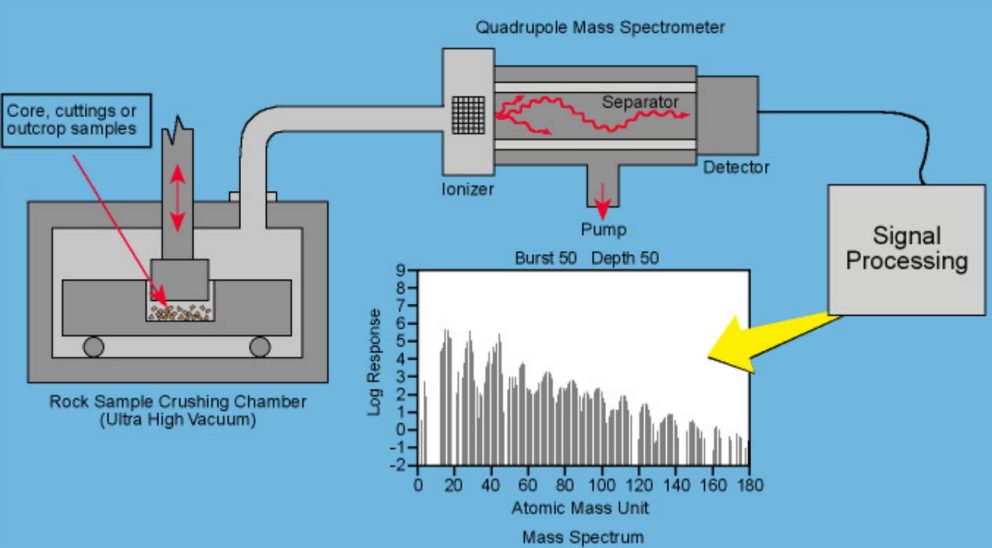
FIS analysis is a patented SLB technique involving the rapid chemical analysis of trapped organic and inorganic volatiles in fluid inclusions that are released through mechanical crushing of core or cuttings samples.
Released volatiles are analysed by quadrupole mass spectrometers to detect the presence and relative bulk abundance of ionised volatile fragments derived from geologically important inorganic species and low molecular weight organic species.
FIS data are plotted as stratigraphic profiles (tracks) to record a relative down-hole FIS response of analysed species and calculated ratios. Appropriate scaling of the data is key to differentiating important signal from background noise. Calibration datasets provide a valuable tool to establish thresholds and demonstrate reproducibility through completion of repeat analyses on the same wells.
Data acquired by the FIS method provides relative rather than absolute responses making data interpretation harder on a well-by-well basis without the benefit of calibration data. Variations across basins with changing lithologies, burial depths, thermal regimes and other geological variables make unambiguous interpretations more challenging when used in a standalone way to interpret the significance of individual well results.
Ascendience Geoscience is pleased to offer a substantial calibration dataset drawn from publicly released FIS data, comprising 380 wells, 180 that have digital data available as .las files. These data provide a valuable calibration dataset using FIS responses from wells with different fluid histories ranging from hydrocarbon discoveries, breached traps and dry holes. The magnitude of observed responses can be scaled more effectively to enable higher interpretation confidence to be achieved.

The Cyclops web-maps platform may be a bit slow to load, we have a lot of wells with fluid inclusion data to display. Once loaded use the map legend to view the different types of data available in our database. In addition to the SLB Fluid Inclusion Stratigraphy data we also have similar analyses using the Exxon proprietary Fluid Inclusion Volatile (FIV) method and the Fluid Inclusion Gas (FIG) technique developed by Geoscience Australia.
Please note that Ascendience Geoscience makes no claim on the copyright or intellectual property rights of these documents that have been collated entirely from public domain sources.
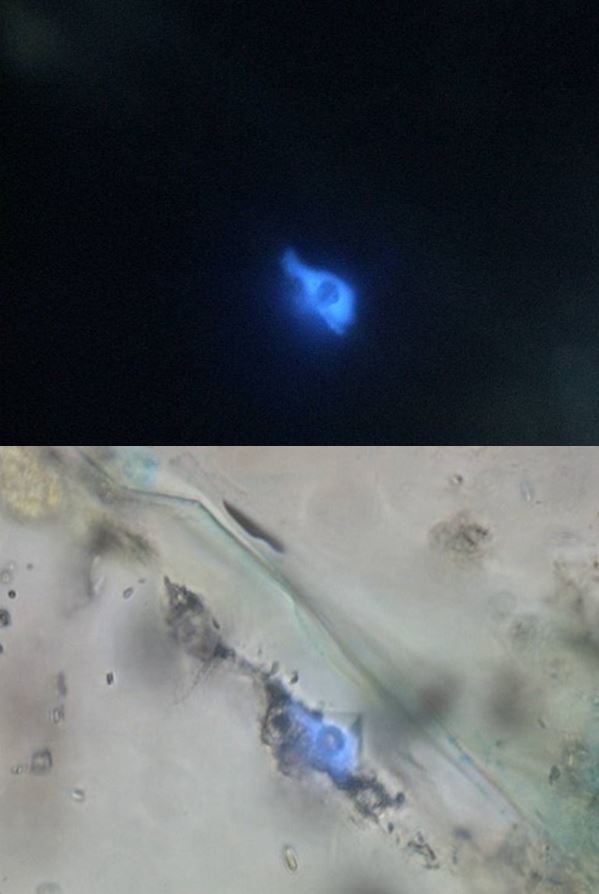
Fluid inclusions represent nature’s MDT tool, able to trap representative and pristine examples of pore fluid that have migrated during geological time. Just like present-day fluids, these samples can reveal much about their origin, chemistry and the accompanying temperature and pressure conditions when they were initially trapped.
Fluid inclusion data are available for retrospective analysis even where no samples of the current reservoir fluids have been retrieved, making these techniques ideal for obtaining critical data from old wells to allow a broader footprint of investigation to be obtained. Analyses can be completed on both core and cuttings samples irrespective of the time or conditions of storage.
The SLB Fluid Inclusion Stratigraphy (FIS) method is one of many tools developed to extract maximum value from analysis fluid inclusions. FIS analysis offers the ability to obtain large amounts of chemical data across the entire sampled section of the wellbore.
Released volatiles are analysed by quadrupole mass spectrometers to detect the presence and relative bulk abundance of ionised volatile fragments derived from geologically important inorganic species and low molecular weight organic species.
The large amounts of data produced by FIS analysis requires consistent and effective interpretation to deliver useful insights and grow petroleum systems understanding beyond the footprint provided by conventional oil and gas shows.
To enable more confident interpretation of FIS data the impact of key variables like depth, temperature, lithology and rock type on FIS response needs to be considered. Access to FIS results from over 180 wells coupled with mud-log show data, petrophysical interpretations and geochemical source rock and fluid analyses, the impact of these variables can be assessed to allow more effective data interpretation protocols to be developed.
Understanding the significance of signal magnitude and the level of background noise associated with FIS response, particularly for evaluation of dry hole outcomes, benefits from reference to calibration data collected on wells with different charge histories. From fields with relatively simple fill history to more complex multi-phase charge events or post-charge alteration by water-washing or biodegradation access to a reference dataset is invaluable to aid more reliable interpretation.
The level of reproducibility is an important factor for building confidence in any analysis tool. Our FIS dataset contains wells that have been analysed for different operators up to five times across multiple years. An investigation of these datasets will provide insights into the ability to reach a similar answer through repeat analysis and highlight areas where concerns are recognised. Considering both precision and accuracy outcomes for repeat analysis further contributes to interpretation confidence.
Ascendience has strong experience in the use of fluid inclusion data to address common questions in petroleum system assessment. Study deliverables will include a comprehensive report that will explore the value of FIS analysis as a powerful tool to evaluate the significance of well results and develop improved interpretation protocols to aid companies in assessment of their proprietary FIS data.